| WAT KHUN MUANG CHAI |
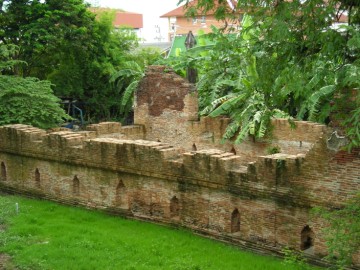
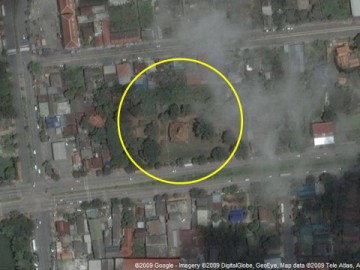
Wat Khun Muang Chai is a large temple ruin located on the city island. It can be
easily found on the northern side of Rochana Road, just before the intersection with
Chikun Road. The Fine Arts Department restored this monastery in 1969-1970 and
once again in 2006.
Wat Khun Muang Chai was once located beside Khlong Pratu Khao Pluak, but this
canal has since been buried. It is most likely featured on several maps by foreigners,
including Vingboons 1660 map and de La Mare 1751 map (though in the latter it is
slightly misplaced). This monastery also appears on Phraya Boran Rachathanin’s 1926
map. Interestingly, Phraya Boran Rachathanin draws it at on northwest/southeast axis.
This seems odd because Wat Khun Muang Chai clearly runs from east to west, and it
perfectly parallels Rochana Road.
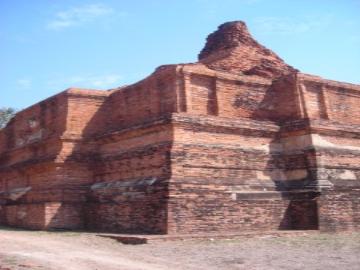
Wat Khun Muang Chai consists of four primary structures: an ubosot, one wiharn, a
large stupa, and a two-story living quarters. Of these structures, the large stupa is
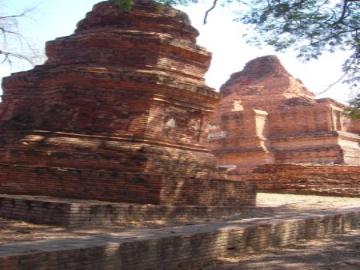
probably the most breathtaking. The tall base of the stupa consists of several layers that
support a bell-shaped body as a type of relic chamber. One layer is superimposed over
another. This style of Thai architecture is known as “Yok Ket”. On the southeastern
side, a surviving corner chedi is still visible. There are very few monasteries resembling
Wat Khun Muang Chai in Ayutthaya (Wat Ayodaya being one of them). This chedi has
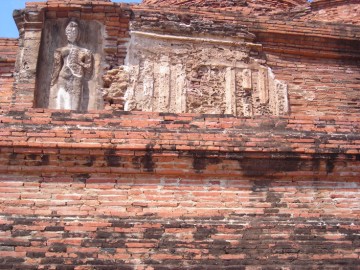
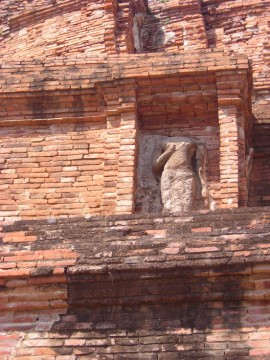
low walls above its indented base that are designed to look like balustrade walls. These
still have some decorative stucco patterns intact - including a few niches where a
standing Buddha image can still be seen. These patterns and Buddha images reflect a
Khmer influence, and there is evidence that several restorations were done on the chedi
during ancient times (TAT 114-115).
There are sermon halls on both sides of the central chedi. These have been restored by
the Fine Arts Department as well. The sermon hall on the western side is very elaborate.
Its foundation is in good shape and a large number of chedi are in situ. One of these
smaller chedi (with a hollow entrance) is at an angle so steep that it appears to be falling
over. The sermon hall on the eastern side is much smaller and more damaged.
Nevertheless, this structure includes some remnants of Buddha images and a reasonable
preserved foundation layer. A large bodhi tree grows out of its altar. A two-story
building is located on the northwestern side of Wat Khun Muang Chai. This type of
structure is associated with residential halls of highly positioned monks or members of the
royal family. There are ones like it at Wat Kudi Dao and Wat Chao Ya.
Wat Khun Muang Chai is a very ancient temple. It may pre-date the establishment of
Ayutthaya in 1351. In fact, this monastery is often connected with Ayodaya - an earlier
settlement east of the city that had a connection to the Lopburi empire. “Archaeologists
have found traces of a pre-12th century Dvaravati town on and below the island of Wat
Khun Muang Chai, Wat Maha That, and Tambon Bang Kracha (Garnier 39-40). This
claim is backed up by a map hanging on the walls of the Ayutthaya Historic Study
Center. The map suggests that there were also a collection of Brahmin shrines north of
Wat Khun Muang Chai. The collection of multiple religious sites within the same
alignment implies that Khlong Pratu Khao Pluak was the boundary of the former
Ayodaya settlement. This belief is supported by a number of historians. “When the city
was founded in the reign of King U-Thong, the eastern perimeter probably stretched
only to Pratu Khao Phluak or Pratu Chin canal, situated in the middle of the island”
(Kasetsiri & Wright 320).
Even though Wat Khun Muang Chai is quite ancient, there are not many records of its
history. Documents refer to it being used for the important ceremony of taking oaths of
allegiance (TAT 114-115). Royal Chronicles mention a Khun Muang who was a noble
during the reign of King Borommatrailokanat, who ruled Ayutthaya from 1448-1463
before ruling in Phitsanulok for twenty years (Cushman 15). A second Khun Muang is
referred to during the reign of King Narai. This man was appointed to the right wing of
the Royal army sent to Sukhothai. An oath of allegiance was taken around that time
(Cushman 253). However, it is uncertain if these passages have any connection to the
monastery.
easily found on the northern side of Rochana Road, just before the intersection with
Chikun Road. The Fine Arts Department restored this monastery in 1969-1970 and
once again in 2006.
Wat Khun Muang Chai was once located beside Khlong Pratu Khao Pluak, but this
canal has since been buried. It is most likely featured on several maps by foreigners,
including Vingboons 1660 map and de La Mare 1751 map (though in the latter it is
slightly misplaced). This monastery also appears on Phraya Boran Rachathanin’s 1926
map. Interestingly, Phraya Boran Rachathanin draws it at on northwest/southeast axis.
This seems odd because Wat Khun Muang Chai clearly runs from east to west, and it
perfectly parallels Rochana Road.
Wat Khun Muang Chai consists of four primary structures: an ubosot, one wiharn, a
large stupa, and a two-story living quarters. Of these structures, the large stupa is
probably the most breathtaking. The tall base of the stupa consists of several layers that
support a bell-shaped body as a type of relic chamber. One layer is superimposed over
another. This style of Thai architecture is known as “Yok Ket”. On the southeastern
side, a surviving corner chedi is still visible. There are very few monasteries resembling
Wat Khun Muang Chai in Ayutthaya (Wat Ayodaya being one of them). This chedi has
low walls above its indented base that are designed to look like balustrade walls. These
still have some decorative stucco patterns intact - including a few niches where a
standing Buddha image can still be seen. These patterns and Buddha images reflect a
Khmer influence, and there is evidence that several restorations were done on the chedi
during ancient times (TAT 114-115).
There are sermon halls on both sides of the central chedi. These have been restored by
the Fine Arts Department as well. The sermon hall on the western side is very elaborate.
Its foundation is in good shape and a large number of chedi are in situ. One of these
smaller chedi (with a hollow entrance) is at an angle so steep that it appears to be falling
over. The sermon hall on the eastern side is much smaller and more damaged.
Nevertheless, this structure includes some remnants of Buddha images and a reasonable
preserved foundation layer. A large bodhi tree grows out of its altar. A two-story
building is located on the northwestern side of Wat Khun Muang Chai. This type of
structure is associated with residential halls of highly positioned monks or members of the
royal family. There are ones like it at Wat Kudi Dao and Wat Chao Ya.
Wat Khun Muang Chai is a very ancient temple. It may pre-date the establishment of
Ayutthaya in 1351. In fact, this monastery is often connected with Ayodaya - an earlier
settlement east of the city that had a connection to the Lopburi empire. “Archaeologists
have found traces of a pre-12th century Dvaravati town on and below the island of Wat
Khun Muang Chai, Wat Maha That, and Tambon Bang Kracha (Garnier 39-40). This
claim is backed up by a map hanging on the walls of the Ayutthaya Historic Study
Center. The map suggests that there were also a collection of Brahmin shrines north of
Wat Khun Muang Chai. The collection of multiple religious sites within the same
alignment implies that Khlong Pratu Khao Pluak was the boundary of the former
Ayodaya settlement. This belief is supported by a number of historians. “When the city
was founded in the reign of King U-Thong, the eastern perimeter probably stretched
only to Pratu Khao Phluak or Pratu Chin canal, situated in the middle of the island”
(Kasetsiri & Wright 320).
Even though Wat Khun Muang Chai is quite ancient, there are not many records of its
history. Documents refer to it being used for the important ceremony of taking oaths of
allegiance (TAT 114-115). Royal Chronicles mention a Khun Muang who was a noble
during the reign of King Borommatrailokanat, who ruled Ayutthaya from 1448-1463
before ruling in Phitsanulok for twenty years (Cushman 15). A second Khun Muang is
referred to during the reign of King Narai. This man was appointed to the right wing of
the Royal army sent to Sukhothai. An oath of allegiance was taken around that time
(Cushman 253). However, it is uncertain if these passages have any connection to the
monastery.


 | |  | |  | |  | |  | |  | |  | |  | |  | |  | |  |


| Text & photographs by Ken May - August 2009 |