Noh Na Paknam
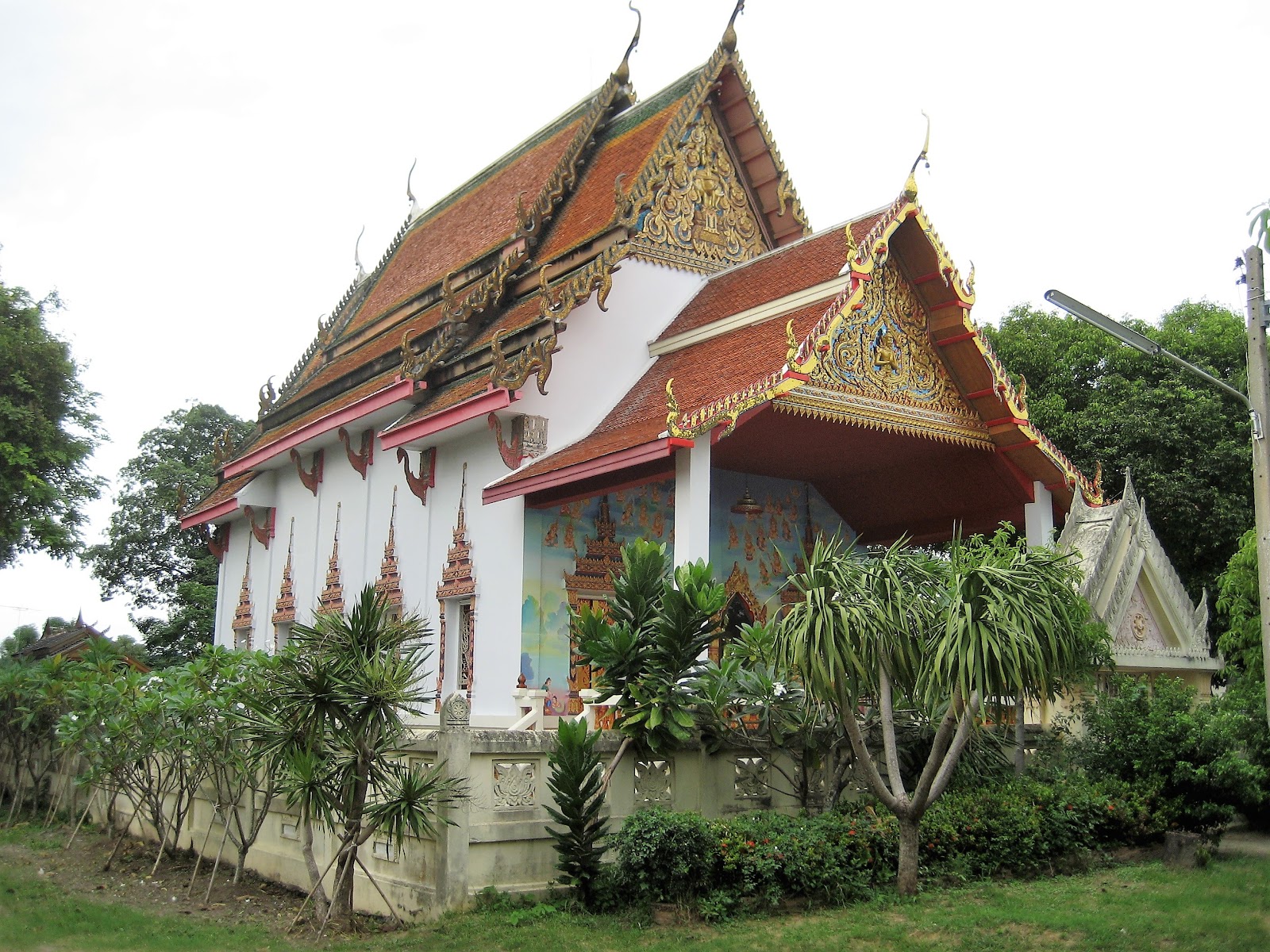
Noh Na Paknam was a prolific writer, art historian, and preservationist who worked closely with Silpakorn University and the Fine Arts Department, and who wrote extensively on Thai temples, antiques, and murals. From November 1966 to March 1967 CE, he spent five months in the Ayutthaya area, visiting known temples and ruins. He visited Wat Intharam in early December 1966 CE. The following is a report from his site visit. The report confirms that all the architectural structures at this monastery date to the post-Ayutthaya period.
"Leaving Wat Maha That, we went to Wat Indraram. I surveyed this temple in April 1958 and found it in ruins. The walls had collapsed, leaving only the foundations, overgrown with weeds. Many artefacts were found there, but it has now been completely restored. The large pagoda behind the main chapel has been destroyed and is gone. The old vihara (assembly hall) is dilapidated and overgrown. No trace remains of what was once an important temple. Later surveyors would be surprised and disbelieved that it was an ancient temple because nothing remained to be seen.
According to survey records from 1958, Wat Indraram is an old temple, with old bricks scattered throughout. The main chapel has been renovated, with windows in the ancient style of five rows of vents on each side, dating back to the early Ayutthaya period. Two doors are at the front and two at the back. The main Buddha image inside the chapel is a stucco sculpture with a long, oval face, indicating it was made in the mid-Ayutthaya period. Several other sandstone Buddha images were also found, including a beautifully sculpted stucco Buddha head the size of a pomelo. The face is square-shaped, suggesting it may be the work of artisans from the early Ayutthaya period, or possibly even earlier.
The roof tiles, preserved from that era, are slender and feature a beautiful design of celestial beings, more exquisite than those found in any other temple. The bricks forming the base of the altar measure 32 x 16 cm. The main Buddha image appears to be stucco from the outside upon closer examination, it reveals cracks, and the interior is made of sandstone. The main Buddha image has a lap width of 2.75 meters. Other sandstone Buddha images with a similar lap width are also arranged on the altar base.
Approximately 8-5 small stone Buddha images, each about 1 meter in size, sit on a terracotta base measuring 65 x 35 cm. According to old records I've kept, the method of assembling these smaller stone-carved Buddha images (about 1 meter in width) was described as being done in three sections: the first section slightly above the forehead, the second section below the neck, and the third section at the navel.
Behind the main chapel there is an octagonal stupa surrounded by twelve-sided pagodas with beautiful decorative patterns. Each side of this octagonal stupa is made into an archway enshrining both standing and seated stucco Buddhas, which are very beautiful. Now the stupa has been completely demolished because the temple is going to make a courtyard behind the main chapel, which is a great pity.” [2]
Wat Intharam on the maps
On a 19th-century map by an unknown surveyor, Wat Intharam is located nearly opposite the entrance to the Khlong Pratu Khao Pluak Canal and Tha Sai (Sand) Landing. Wat Phihan Thong stood to the east, while Wat Rong Khong was to the west. The map shows no stupa.
On Phraya Boran Rachathanin's [PBR] map of 1926 CE, we find an identical situation. Wat Phihan Thong is renamed Wat Wihan Thong, replacing the old word 'phihan' with the modern 'wihan'. The same applies to 'Taphan', which is now 'Saphan' (bridge). PBR still uses Wat Rong Khong, which is now Wat Wong Khong. The renaming of ‘Rong’ to ‘Wong’ is related to superstition: ‘rong’, which means building, also sounds like a coffin (Th: long). The word ‘rong’ was not considered a very auspicious name for a temple, hence the name change. The same occurred to Wat Pradu Songtham, which was previously two temples, Wat Pradu and Wat Rongtham. Here, Rongtham was changed to Songtham..
Wat Intharam is at the geographical coordinates: 14° 21' 54.41" N, 100° 34' 3.85" E.
References:
[1] Whitney, William Dwight (1979). A Sanskrit grammar including both the classical language, and the older dialects, of Veda and Brahmana. Leipzig, Breitkopf & Härtel. p. 159 #473.
[2] Uluchada, Prayoon aka Noh Na Paknam (2527). Five Months in the Midst of Ayutthaya's Brick Rubble. (Hā Dư̄an Klāng Sākʻit Pūn Thī ʻAyutthayā). Bangkok.