| THE ARCHITECTURE OF WAT PHRA SRI SANPHET |

 | |  | |  | |  | |  | |  | |  | |  | |  |
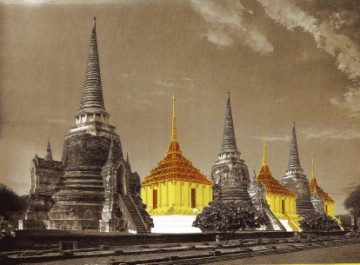
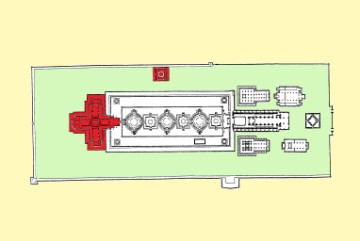
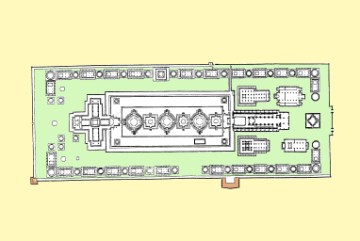
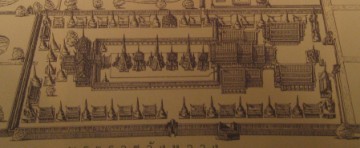
| The monastic structures in Wat Phra Sri Sanphet were basically straight aligned on an east-west axis. The main entity was formed by the prasat, the three chedis with their mandapas, and the Royal vihara or chapel presiding over all structures. The three chedis, being the core of the temple, rested on a high platform with the later built mandapas (square structures with a spire) situated at the eastern side of each chedi. The elevated platform was surrounded by a walled gallery, running from the westside of the Royal chapel towards the eastern portico of the prasat, a cruciform structure. On both sides of the Royal chapel were minor vihara aligned north to south. On the north side stood the Vihara Phra Lokanat (the Vihara of the Protector of the World). On its south side stood the Vihara Phra Palelai (the Vihara of the Parileyyaka Buddha). A parallel north-south alignment was formed by the ordination hall (Vihara Phra Palelai) and by the Sala Chom Thong (east of Vihara Phra Lokanat). The bell tower stood nearly in the same axis, but in front of the Royal chapel. We will define some of these structures by following more or less the timeline of construction of the monastery. |

| Text & photographs by Tricky Vandenberg - April 2010 Updated August 2016 |
 | |  | |  | |  | |  | |  | |  | |  |
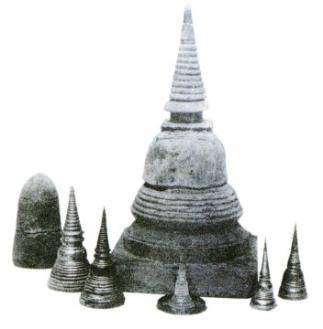
The first chedi on the eastern side was constructed by King Ramathibodi II (r. 1491-1529) in 1492 A.D. to enshrine the ashes of his father, King Borommatrailokanat (r. 1448-1463). On the inner wall of the crypt is a mural painting on lead sheets believed to be from the period of the construction of the chedi, depicting Buddhist monks walking while holding lotus flowers in their clasped hands. Fine Arts Department (FAD) found during excavations in 1932 in this chedi a stupika consisting of eight smaller stupas, one enclosing the other likely to have contained the relics of the deceased king. The outer stupa crumbled. The other seven are on display at the Chao Sam Phraya Museum. |
| The second chedi - the present middle one - was built at the same time of the first, to enshrine the ashes of his elder brother, King Borommaracha III (r. 1463 -1488). The two chedis were lined up on an east-west oriented axis. Eight years later, a Royal vihara was constructed in the same alignment of the chedis. The third and western chedi was built 40 years later by King Boromracha IV (r. 1529-1533) to enshrine the remains of his father, King Ramathibodi II. All three bell-shaped chedis are identical and were constructed on a rectangular platform. The chedis are built in the Sukhothai style - derived from the Srivijayan stupa, characterized by superimposed pedestals - only differing from the latter that they have four outward-jutting porches in the four cardinal directions, decorated with a small – identical to the main chedi – stupika on the roof of the porch - a feature probably derived from the Khmer architecture. The porches have a niche in which a standing Buddha image was placed on three sides. The porch on the east side gave access to the garbhagrha, a small sacred chamber in the interior of the chedi in which consecrated objects, in this case the King’s ashes, were contained. A typical feature of the Ayutthaya-styled chedi is the presence of vertical pillars (Th: Sao han) decorating the shaft and supporting the spire above the harmika. The vertical pillars break the monotony of the repetitive horizontal rings of the pinnacle. It is a characteristic differing from the Sukhothai-styled stupa and this design was probably for the first time here initiated. The chedis of Wat Sri Sanphet demonstrate thus the beginning of a new architectural style, influenced by the Sukhothai art, at the same time abandoning the prang-styled construction of the Early Ayutthaya Period. |
| Vihara Luang or Royal Chapel The Royal chapel was built in 1499 in the reign of King Ramathibodi II, prior of course the construction of the third chedi, which would contain the latter’s ashes. The initial vihara had eleven sections of approximately 4.6 meter length, totaling a length of 50 meters. The construction stood isolated from the two chedis already built. The building had a front and back porch, with two entries each. The walls had no windows, but vertical slit openings, bringing ventilation and providing at the same time a diffused light into the inside. Apparently even the back wall had these openings. The gabled roof was supported by two rows of pillars in the interior of the chapel and two rows of pillars at the exterior, forming as thus a colonnade at each side of the building, an architectural style from the Middle Ayutthaya Period. Also here is Sukhothai art influence visible as some columns still bear capitals in the form of a stylized lotus. As the gables and tiled roofs were wooden structures, it is clear that the chapel must have undergone many restorations When visiting the structure, a pedestal inside the chapel, where upon once a golden Buddha images stood, can still be seen; including some stucco displaying parts of a lion’ s foot. The pedestal in the back has been reduced to a pile of rubble. The chapel has undergone two major restorations. During the reign of King Prasat Thong (r. 1629-1656) the building was extended at the back, in a way that the 1.6 m wide stairs of the back porch penetrated and entered the newly built gallery. The second renovation took place during the reign of King Borommakot (r. 1733-1758). The walls of the front porch were dismantled and six more pillars were erected to support an additional roof section. |
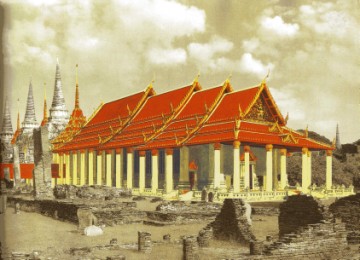
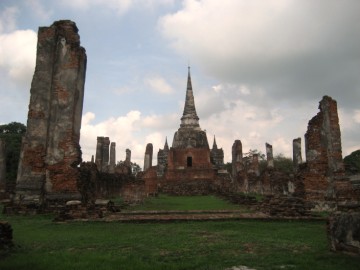
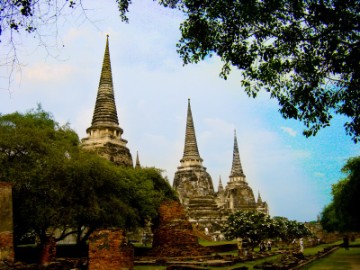
| The gallery A gallery, surrounding the three main chedis and incorporating partly the back porch of the Royal Chapel, was built during the first major renovation in the reign of King Prasat Thong. Buddha images in the Subduing Mara posture were installed inside the gallery, facing outwards (back to the chedis); a bit unusual since Buddha images in a gallery face usually inward. On the four corners of the gallery, small pagodas - named "Phra Agghiya chedi" - were constructed in an identical style as the principal chedi. |
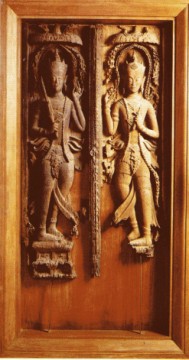
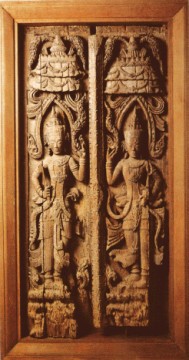
| The prasat The prasat (2) at the west side of the temple was a building which served religious purposes, being a shrine for venerated objects or memorial hall. The ground-plan was a Greek cross, while the roof-structure ended in a slender prang. The prasat is a direct stylistic descendant of the Khmer temple. A square sanctuary with a domed sikhara (tower) and four porch-like antechambers that project from the main building, giving the whole temple a multileveled contour. The building was added during the reign of King Narai. The ubosot The ubosot or ordination hall was located on the southeastern side of Royal Chapel and east of Vihara Palelai. The hall was rectangular and measured 33 meters by 15 meters. The structure was made of brick and initially open sided. The building was restored a number of times at par with the other monastic structures in situ. During probably the first renovation in the reign of King Prasat Thong walls were erected to close the structure, while the pedestal for the Buddha image inside the ubosot was extended to seal off the back portico. As most monastic structures the roof structure was made of wood and covered with unglazed terra-cotta tiles. The boundary stones (Th: bai sema), made of slate are believed to be the originals as they bear the characteristics of the Middle Ayutthaya period (1488 to 1629 AD). The door panels of the ubosot survived the Burmese war of 1767 and are displayed at the Chao Sam Phraya Museum. The panels are made of wood and measure 1.10 meters by 2.40 meters. They were beautifully carved in high-relief depicting Dvarapala (3) and are testimony of the exquisite Ayutthayan art. Sala Kanparian The Sala Kanparian was a building where the monks studied the Buddhist scriptures. Wat Phra Sri Sanphet had such a building, named the Jom Thong Pavilion, though there were no monks residing in the temple. This pavilion was situated east of vihara Phra Lokanat and contained a Buddha in sitting posture called Phra Jom Thong. This location is referred to in the Royal Chronicles of Ayutthaya as being the place where King Song Tham was listening to the monks explicating books at the start of a rebellion of some Japanese traders in 1611. The latter were already present at the palace eager to find the King. Eight monks of the Monastery of the Pradu Three (the present Wat Pradu Song Tham) escorted the King away in front of the baffled Japanese, who undertook no action against him. Jom Thong Pavilion also called Phra Thi Nang Jom Thong was built on a rectangular base. It had three porticos, one in front and the other two at the sides. Inside the building there were two rows of pillars supporting the beams with seven partitions (space between the pillars). The roof was tiered and gabled with rows of pillars supporting the eaves similar to Sukhothai architecture. Dutch merchant Jeremias Van Vliet wrote in his work 'Description of the Kingdom of Siam' (1638) that the original books of King U-Thong or Ramathibodi I, first King of Ayutthaya, were kept at Wat Phra Sri Sanphet. These manuscripts were probably kept at the Jom Thong pavilion. [3] "All these laws and foundations of religion he has written himself and has bequeathed them to his subjects. These original books, together with many others which were added in later years, are still kept in Judia in the king’s finest temple, now called Wat Siserpudt, and are held in great honor." |
| The chapels Twenty-six chapels consisting each of a vihara and a bell-shaped chedi in Ayutthayan style, were built along the outer wall, within the monastery compound. The ashes of the members of the royal family were kept inside these chedis. Traces of lime stucco still can be found on the walls of a vihara on the south side of the temple. The bell tower The bell tower has undergone three restorations. A new structure was built over the original gong and drum tower, made with brick columns and a wooden floor. The last restorations had a five-tiered rooftop and four porticos. The inner wall Although important monastic structures, such as an ubosot or royal vihara were traditionally surrounded by a low inner wall - separating the sacred world from the secular hustle and bustle outside - no such wall could be found on the premises of Wat Phra Sri Sanphet. The Royal Chronicles although mention the existence of an inner wall during King Prasat Thong’s reign. The records mention the king visiting the Royal chapel and encountering a son of the King Songtham, the young Prince Athittayawong sitting on the wall. The prince did not descend the wall on approach of the king to pay his respects and was straight punished to become a commoner to live near Wat Tha Sai. "His Majesty came on a tour in front of the large holy preaching hall and, glancing with His holy eyes, saw Holy Athittayawong, the royal son of Holy-Lord Song Tham who had been removed from the royal wealth, ascend and sit dangling his feet upon the back of the crystal wall. Indicating him with His holy hand the King said, Athittayawong is rash in failing to descend from the crystal wall in order to be lower than the King. Indicating him with His holy hand the King said, Athittayawong is rash in failing to descend from the crystal wall in order to be lower than the King. Strip Holy Athittayawong of his rank and send someone to build two houses with bamboo posts and two rooms beside the Monastery of Sand Landing for Athittayawong to have two people live with him - just enough to stay to dip up water and cook rice." |
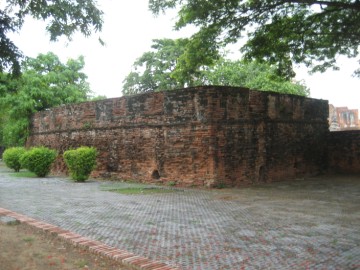
| The outer wall and bastions The Phra Sri Sanphet monastery is surrounded on all sides with a high thick brick wall with embattlements on the top. There were four gates built in the cardinal directions. The southern gate giving access to the front court of Wihan Mongkhon Bophit, was called "Pratu Bowon Nimit" or "Gate of the Excellent Omen". Pratu Chong Kut, the western gate, gave access to the Tamnak Suan Kratai or the Rabbit Garden Royal Pavilion. The western gate gave access to the inner court of Phra Thi Nang Jakkrawan Phaichayon (throne hall), while the northern gate was the entry to the palace. The entry was a long covered corridor (Th: chanuan) running through the palace area from Tha Wasukri in the north until Wat Phra Sri Sanphet in the south, offering discretion and shade. The monastery had two forts. A main fort called Pom Sala Phra Wihan Mongkhon Bophit was a semi-large bastion protecting the southern part of the palace area. From the protruded bastion, soldiers could control the whole southern wall. A second smaller bastion called Pom Mum Wat Phra Sri Sanphet stood on the southwestern corner of the monastery's premises. This page has been partly based upon an analysis by Aphivan Saipradist (See consulted works) Footnotes: (1) A mondop is a building with a square structure and a stepped pyramidal roof, built to house objects of special veneration - a Buddha image or footprint. (2) Skt: Prasada or castle was a residence of a king or god. The term is generally used in the sense of sanctuary tower (Khmer). (3) "Guardian of the Gate" also known as the protector of shrines; often standing and holding a club, frequently at the entrance to a temple. |
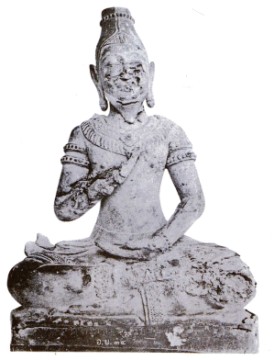
| (Bodhisattva image found in situ - Chao Sam Phraya National Museum) |
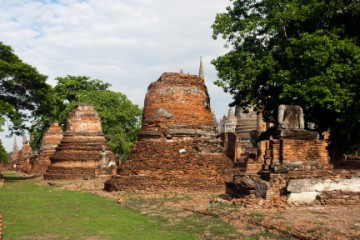

| Construction of Wat Sri Sanphet) |
| (Door panels of the ubosot - Chao Sam Phraya National Museum) |
| (Pom Sala Phra Wihan Mongkhon Bophit) |
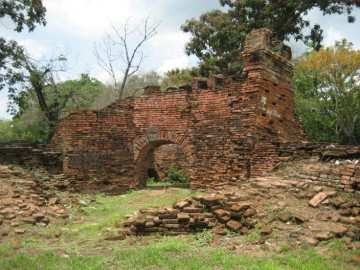
| (Pom Mum Wat Phra Sri Sanphet) |
| The mandapas There were four mandapas (Th: mondop) (1) constructed in Wat Phra Sri Sanphet. The first three were built on the square base between the three main chedis. These mandapas had a spired top. Scholars assume that the mandapas may have been built in the reign of King Prasat Thong. A fourth mondop was constructed close to the northern wall of the temple. The structure of this mondop deviated from the classic one, as it was a cruciform structure topped in the middle with a small prang; a bit a mixture of a prasat and a classic mandapa. The doors and windows were in gothic style, bearing French influence. Scholars assume it was built during the reign of King Narai and housed the remains of his father King Prasat Thong. |
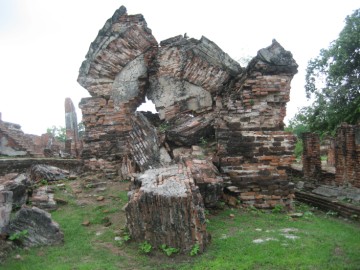
| (Remnants of the gallery) |
| (The three mandapas on the square base) |
| Questioning the construction date of Ayutthaya's landmark The dating of the Ayutthaya monuments is commonly based on the dates mentioned in the Royal Chronicles of Ayutthaya written in the Early Ratanakosin period. Piriya Krairiksh in his document "A Revised Dating of Ayudhya Architecture" brings to the attention that the possibility might exist that the monuments we see today may have been built at a later period. [4] Piriya Krairiksh arguments that there is nowhere written in the old documents that the ashes of King Borommatrailokanat and King Borommaracha III were enshrined each in a stupa (hence enshrined in two stupas), while there is also no indication of the location of the stupa nor a mentioning of a specific temple. The oil painting of "Iudea" of c. 1659 in the Rijksmuseum, Amsterdam and the watercolour painting from Johannes Vingboons' atlas of 1665 does not depict a stupa at the rear of Wihan Luang, and therefore he believes the timing of the construction of the three stupa should be revised. (1) Referring to the "Plan of the Royal Palace of Siam" published by Engelbert Kaempfer, he concludes that the chedis seen on the plan are probably built between 1665 and 1688 during the reign of King Narai, since all of these additional structures are missing on Vingboons' atlas of 1665. He also remarks that the chedi on Kaempfer's plan are of the multi-storeyed prasat type and not of the present bell-shaped Sinhalese type. Krairiksh writes that if we compare the present architectural lay-out of Wat Phra Sri Sanphet with Kaempfer's plan of 1690, nothing of the structures shown in the latter plan remains. The Royal Chronicles of Ayutthaya mention that King Borommakot ordered the complete renovation of Wat Phra Sri Sanphet in 1742, which makes Krairiksh assume that the earlier structures had been demolished and replaced by three Sinhalese-type stupas alternated with three mandapa, laid out along an east-west axis following a symmetrically designed master plan from the early 1740s. I agree with Krairiksh in questioning the date of construction of the three bell-styled chedi of Wat Phra Sri Sanphet set at the end of the 15th century following the chronicles. No Siamese construction from the past survived a long time in the torrid zone in its original form; add to this that the Siamese were far from industrial to maintain their temples and let them mostly dilapidate overtime, to finally pull them to the ground and rebuilt them thereafter. The chronicles mention that the complete renovation of Wat Phra Sri Sanphet by King Borommakot (r. 1733 - 1758) in 1742 took more than one or two years depending the versions. It is as thus plausible that older structures were completely torn down and replaced by new ones (in another style), as we have the same case with Chedi Phukhao Thong. King Borommakot had the chedi rebuilt in 1744 on a square pedestal with indented corners and niches on the four sides, while the cylindrical dome was changed to one of a square plan with rabbeted angles. The three bell-styled chedi of Wat Phra Sri Sanphet could as thus only date back to the mid-18th century and should as thus no be taken as a main example of the second architectural sub-period (1488 to 1629 AD), but rather as part of the fourth sub-period (1732 - 1767 AD). Footnotes: (1) Krairiksh uses a wrong element from the oil painting "Iudea", the structure being Wat Maha That instead of Wat Phra Sri Sanphet. References: [1] Angkor, an introduction to the temples - Dawn F. Rooney (2003). [2] The Royal Chronicles of Ayutthaya - Richard D. Cushman (2006) - page 217 / Source: Phan Canthanumat, British Museum, Reverend Phonnarat, Phra Cakkraphatdiphong & Royal Autograph. [3] Chris Baker, Dhiravat Na Pombejra, Alfons Van Der Kraan & David K. Wyatt. (2005) - Van Vliet's Siam - Silkworm Books - page 106. [4] Piriya Krairiksh - A Revised Dating of Ayudhya Architecture (II) - Journal of the Siam Society, Vol 80.2 (1992). Consulted works: 1. A critical analysis of heritage interpretation and the development of a guidebook for non-thai cultural tourists at Ayutthaya world heritage site - by Aphivan Saipradist - Silpakorn University (2005). 2. An Outline of the History of Religious Architecture in Thailand - Sonthiwan Intralib (1991). |