| WAT CHEDI DAENG (วัดเจดีย์แดง) |
| Wat Chedi Daeng is located north of the main island on the Phaniat peninsula. Khlong Bang Khuat (the old Lopburi River) flows to its west, and Khlong Chang is situated directly north of the monastery. Wat Chedi Daeng is an active monastery. It is prized by many locals who believe the monks have special powers for casting spells that can protect motor vehicles. Many people come here from all over the city to have monks bless their cars and motorcycles. In contrast to its name, there is not actually a red chedi in situ at the temple. A bell tower (painted red) and a small bell-shaped chedi are viewable by boat from Khlong Bang Khuat. There is also a large redented chedi behind the sermon hall, which is in the Late Ayutthaya period style. A number of smaller monuments exist at this site with unusual designs. For example, there is a statue of Erawan with four faces pointed in each of the cardinal directions. There is also an odd statue of a turban-wearing Brahmin priest with a cat-like creature perched beside. The date of these structures is not clear, but most of them reflect the Ratanakosin period. Historically, Wat Chedi Daeng played an important role in a number of conflicts. King Borommakot (1733-1758) set up an army of 10,000 troops at Wat Chedi Daeng to prepare for battle with Cambodia (Cushman 449). In 1767, a group of 2,000 Chinese troops volunteered to cross Khlong Chang and set up stockades at the elephant kraal and Wat Chedi Daeng to protect the city from Burmese invasion. Unfortunately, these professionally-trained soldiers lacked enough time to reinforce proper stockades. When the Burmese attacked, the Chinese troops were forced to flee to land opposite the river (Cushman 482). The Burmese army of King Mengra then set up army camps around the city of Ayutthaya. One of the stockades was reinforced with bastions at Wat Chedi Daeng. Nemiao, the general of the armies in the stockade at the Three Fig Trees, had the Burmese troops burn down that palace at the Elephant Kraal. Then he had them set up stockades at the Monastery of the Holy Red Funeral Monument, at the Monastery of the Three Preaching Halls, at the Monastery of the Spired Building, at the at the Monastery of the Tent, at the Monastery of the Glorious Fig. Bastions were constructed in each and every stockade, large and small guns taken up into them, and then these were fired at the Capital (Cushman 517). Ayutthaya fell soon afterward. |

 | |  | |  | |  | |  | |  | |  | |  | |  |

| Text by Ken May - July 2009 |
 | |  | |  | |  | |  | |  | |  | |  |
A few issues in the text above need to be set historically or geographically right. Wat Chedi Daeng is not situated along Khlong Bang Khuat, but along Khlong Hua Ro and Khlong Daeng. Khlong Chang is not situated directly north of the monastery but about 4 Km more to the north. King Borommakot set up an army at Wat Chedi Daeng (Monastery of the Holy Red Funeral Monument) in 1750, a year of the Horse, in order to assist the Khmers (not to attack the Khmers) in fighting off an attack of the Vietnamese. Meanwhile, over in the Country of Kamphut, the Eminent Holy Satha Ong Ing went to ask for the brigades of a Yuan army to come and attack the Capital of Kamphuchathibòdi. Now the Eminent Holy Ramathibòdi and the Eminent Holy Si Chai Chet were unable to battle the Yuan and thereupon led Their voluntary groups of followers in fleeing, routed, on in to seek the protection of the Accumulation of Merit of the Holy Paramount Fig Tree by way of the Municipality of Pracinburi. The government officials of the Municipality of Pracin sent a report document on in and the Chief Magistrate prostrated himself in homage and told the King. The King thereupon manifested His holy compassion by being pleased to send crown servants out to bring both of the Khmer lords, and Their voluntary groups of followers, on in to the Holy Grand Metropolis. Then the King issued a holy royal proclamation commanding ten thousand troops be conscripted and sending Phraya Ratcha Suphawadi out to encamp and assemble the troops there at the Monastery of the Holy Red Funeral Monument. [1] In 1767 two thousand Chinese volunteers under Luang Aphai Phiphat, intended to stop the Burmese by trying to put up a stockade at Pho Sam Ton area across Khlong Chang. Mün Thip Sena, reinforced the Chinese in the rear by encamping one thousand troops at Wat Borommawong (Monastery of the Sea of Grass). The Chinese troops did not set up stockades at the Elephant Kraal, neither at Wat Chedi Daeng. Thereupon Luang Aphai Phiphat, the Chinese, prostrated himself to address the King and volunteered to go forth to fight. He managed to organize a group of two thousand Chinese masters of the kai, advanced forth from the municipality, crossed the Canal of the Elephants and would have gone to erect a stockade. The King was thereupon pleased to vest Mün Thip Sena, the Deputy of the Department of the Holy Police on the Right, with one thousand troops to advance forth to reinforce and wait to assist [Luang Aphai Phiphit]. [Mün Thip Sena] encamped his troops at the site of the ecclesiastical gaol of the Monastery of the Sea of Grass. [2] The Burmese in their final attack on Ayutthaya in April 1767 had established at Wat Chedi Daeng one of their many stockades, from which the Siamese capital was invested. The general of the armies thereupon had the army masters and brigade masters of the stockades at the Monastery of the Three Preaching Hall, the Monastery of the Holy Red Funeral Monument and the Monastery of the Spired Building conscript troops of soldiers and advance forward to build a bamboo slat bridge across the Mother of Waters at the Head of the Sluice beside the Fort of Grand Victory. [3] The temple is situated in geographical coordinates: 14° 22' 29.28" N, 100° 34' 15.60" E. References: [1] The Royal Chronicles of Ayutthaya - Richard D. Cushman (2006) - page 449 / Source: Royal Autograph - Cambodian-Vietnamese Warfare. [2] Ibid - page 481 / Source: Royal Autograph - Chinese Volunteers. [3] Ibid - page 520 / Source: Royal Autograph - Ayutthaya Falls to the Burmese. |
| Addendum, maps & photographs by Tricky Vandenberg - April 2012 Updated April 2014 |


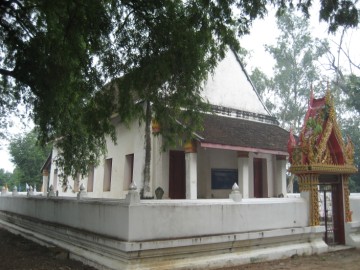
| (View from the southeast) |
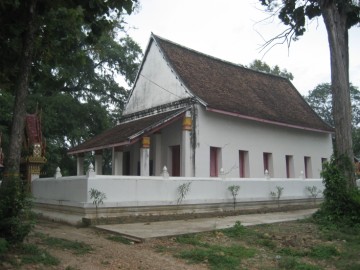
| (View from the northeast) |
| (Ordination hall of Wat Chedi Daeng) |
| (Funeral area of Wat Chedi Daeng) |
| (Inside the ordination hall) |

| (Detail of a 2007 Fine Arts Department GIS map - Courtesy of the Fine Arts Department - 3th Region) |
